
Nature & wildlife
Birdwatching in Morocco: where to go, when, and what you might see
From the alpine meadows of Oukaïmeden to the dunes of Erg Chebbi: Morocco's finest birding regions, the seasons that suit them and the species worth planning a journey around.
By Go Beyond Morocco6 min read
Few countries pack so many landscapes into a single week of driving. In Morocco you can scan an Atlantic estuary at dawn, climb to alpine meadows above 2,600 metres two days later and fall asleep beside the dunes of the Sahara before the week is out. For birders that compression matters: the north holds a Palearctic avifauna that feels familiar to European eyes, while the south slides into desert and Afrotropical species found nowhere near Europe. Around 500 species have been recorded in the country, and a handful of them are North African specialities that bring birders back year after year.
This guide covers the main regions, the seasons, the species worth planning around and a few principles for watching them well.
Where to go
Most spring journeys follow a southern circuit from Marrakech, through the mountains, the Atlantic coast and the edge of the Sahara. Two northern regions suit a longer or a winter itinerary.
The High Atlas: Oukaïmeden
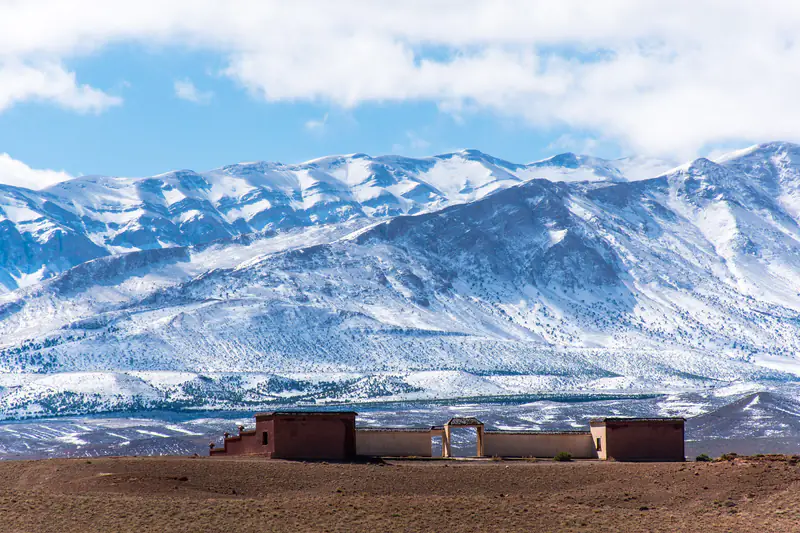
About two hours south of Marrakech, a winding road climbs to Oukaïmeden, a small ski station whose slopes run from roughly 2,600 to 3,200 metres. Once the snow retreats in spring, its grazed meadows and boulder fields hold the birds of the high Atlas:
- African crimson-winged finch, a mountain finch of the Atlas, often feeding in loose flocks around the car parks early in the morning;
- the Atlas form of horned lark, black-masked and strikingly marked;
- red-billed and Alpine choughs, tumbling over the ridges;
- rock sparrow, Seebohm's wheatear and, in the colder months, Alpine accentor.
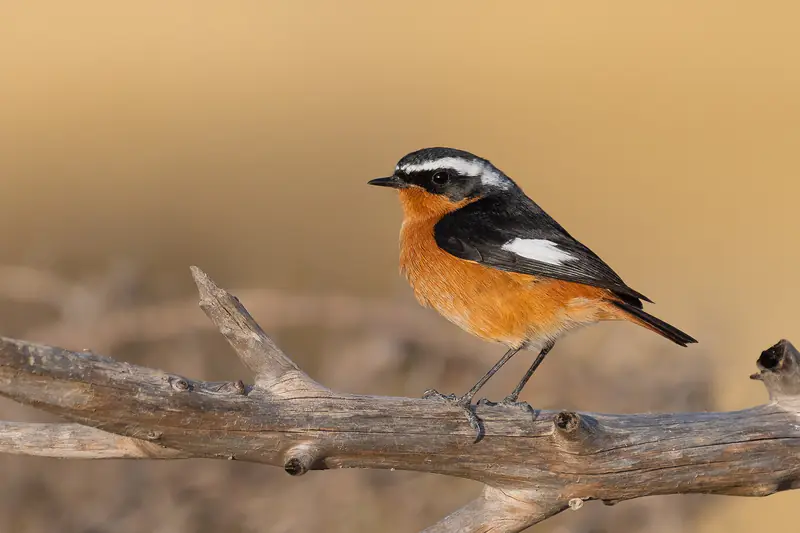
On the lower slopes, on the way up, look for Moussier's redstart, a small, brilliantly coloured North African endemic, and Levaillant's woodpecker, the green woodpecker of the Maghreb. Take the altitude seriously: the meadows are gentle, but walking at that height leaves most visitors short of breath.
The Atlantic coast: Souss-Massa and Tamri
South of Agadir, Souss-Massa National Park was created in 1991 and covers about 33,800 hectares of coastal dunes, cliffs, steppe and two river mouths. The Souss estuary at its northern end draws waders, gulls and, in winter, spoonbills and Audouin's gulls. The Oued Massa, near the centre of the park, holds water all year, and marbled ducks, a globally threatened species, breed along it.
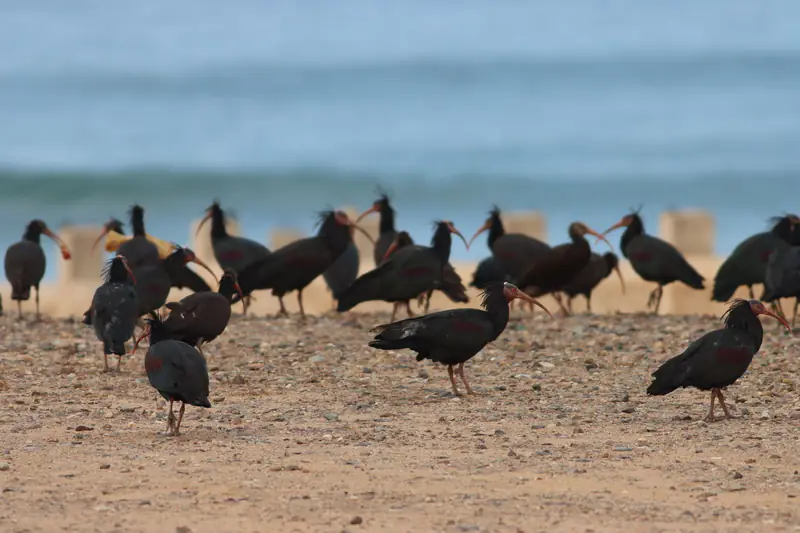
The park, together with the cliffs at Tamri about 55 kilometres north of Agadir, is also the last stronghold of the wild northern bald ibis. Flocks forage in the sandy steppe and coastal fields, sometimes surprisingly close to the road. The breeding cliffs themselves are protected and closed to visitors, and rightly so. We tell the full story of this bird in our guide to the northern bald ibis.
The stony steppe: the Tagdilt track and the Dades
On the eastern edge of Boumalne Dades, the Tagdilt track crosses a flat, shadeless plain of stones and sparse scrub. It is not pretty (part of it is a municipal tip, watched over by feral dogs), but it is one of the best places in North Africa for the birds of the hamada:
- thick-billed lark, the bird most visitors come for, though it can turn elusive once nesting begins;
- Temminck's lark, bar-tailed lark and greater hoopoe-lark;
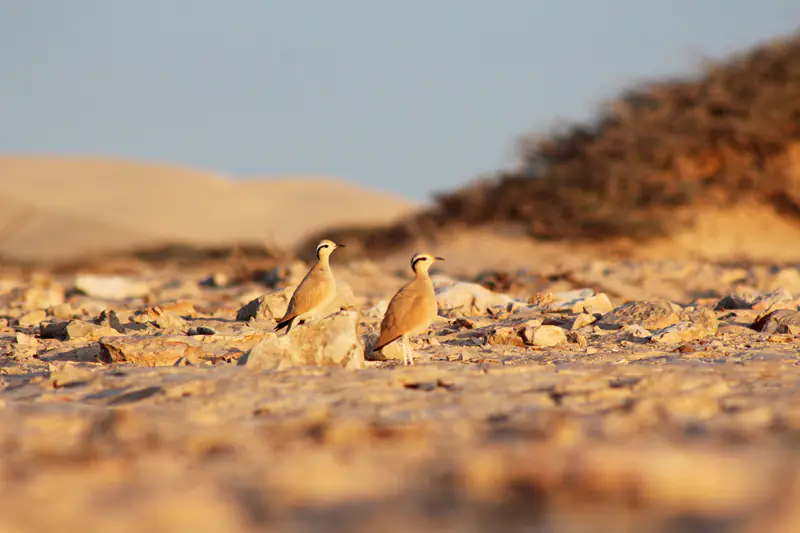
- cream-coloured courser, running and freezing across the open plain;
- red-rumped wheatear, pin-tailed sandgrouse, trumpeter finch and the occasional Barbary falcon.
Come early or late in the day, when the light is soft and the birds active. The Dades gorge, a short drive north, adds cliff-nesting species and a very different mood, and sits on the route described in our journey along the Road of a Thousand Kasbahs.
Merzouga and Erg Chebbi
The great dunes of Erg Chebbi bring the desert specialities within reach. With a good local guide, who will know where the birds have been roosting that week, the list here can include:
- desert sparrow, now often found around nomad encampments rather than the hotels at the edge of the sand;
- Egyptian nightjar, a pale, perfectly camouflaged bird that spends the day on the ground, most likely between March and September;
- African desert warbler, fulvous babbler, brown-necked raven and, with luck, Pharaoh eagle-owl.
When winter rains have been generous, the seasonal lake of Dayet Srji, near the village of Merzouga, fills and can attract greater flamingos, ruddy shelducks and marbled ducks. In dry years it is simply a pan of cracked earth, so treat it as a bonus rather than a promise. For the dunes themselves, and how Erg Chebbi compares with the more remote Erg Chigaga, see our guide to choosing your Sahara.
The north: Middle Atlas cedars and Merja Zerga
Around Ifrane, in the Middle Atlas, forests of Atlas cedar and holm oak hold Levaillant's woodpecker, hawfinch, African blue tit and the Atlas pied flycatcher, which only returns to its breeding woods at the end of April. The lake of Dayet Aoua has been dry in recent springs, yet the woodland along its shore remains productive.
On the Atlantic coast north of Kenitra, Merja Zerga is a tidal lagoon that opens to the ocean at the fishing village of Moulay Bousselham. Protected since 1978 and designated a Ramsar wetland of international importance in 1980, it regularly holds tens of thousands of wintering ducks and waders, flocks of greater flamingos, and a resident population of marsh owls. It was also one of the last places where the slender-billed curlew was recorded, in the 1990s; the species is now feared extinct.
When to go
- Spring (late February to May) is the classic season. Residents are breeding and singing, northbound migrants pass through, and the high meadows open as the snow melts. Most visitors come between March and May.
- Autumn (September and October) brings the return passage of migrants and milder heat in the south.
- Winter (November to February) is the time for wetlands: Merja Zerga, the Souss and the Massa at their fullest, with the High Atlas often under snow.
- Summer (June to September) is hot and quiet in the south, and best avoided for desert birding.
For a wider view of the seasons beyond birds, see our guide to the best time to visit Morocco.
Watching with care
Morocco's specialities are often scarce, and some live close to people. A few habits keep the birding good for everyone:
- Leave playback at home, especially in the breeding season. A call played repeatedly can drive a bird from its territory.
- Give nests and roosts room. A nightjar on its day roost should be watched from a distance and never flushed for a better photograph.
- Stay on tracks in dunes and steppe, where nests are on the ground and easily crushed.
- Respect closed areas, starting with the bald ibis colonies.
- Work with local guides. Their knowledge is irreplaceable, and it gives local communities a reason to value the birds.
Travelling it with us
Our ten-day Birdwatching in Morocco journey follows the southern circuit described here, from Marrakech to Marrakech, at its best between March and May: Oukaïmeden, the Souss estuary, Tamri and Souss-Massa for the bald ibis, the Tagdilt track and the Dades, then Merzouga and Erg Chebbi. If your list leans towards the cedar forests, the winter lagoons or a different season altogether, we are happy to shape a private journey around it. Tell us what you hope to see.