
Food & drink
Moroccan mint tea: the ritual behind the glass
Green tea from China, fresh mint and a generous hand with sugar: how Morocco made a 19th-century import its gesture of welcome, and how to receive it well.
By Go Beyond Morocco6 min read
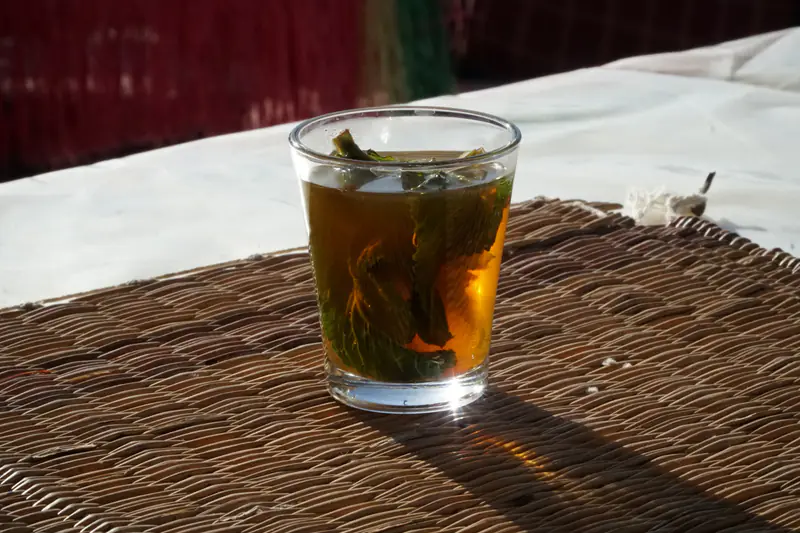
Sooner or later it happens to every traveller in Morocco. In a carpet shop in Fez, a village house in the Atlas or a tent at the edge of the dunes, someone sets down a round tray, lifts a teapot well above the glasses and sends a thin amber stream into each one. A glass is handed to you, too hot to hold anywhere but the rim. It is sweet, fresh with mint and faintly bitter underneath. It is also, without anyone saying so, a welcome.
Moroccans call it atay, and they drink it at every hour: after meals and between them, in offices and garages, at weddings and at the end of a long drive. Behind each glass lies a surprisingly recent history, a precise technique and a set of manners worth understanding before your first invitation.
A Chinese tea, a Moroccan habit
Tea is not native to Morocco, and its arrival is more recent than the ceremony suggests. It was already known in some elite households (a British traveller, James Richardson, described a Moroccan tea service in the 1840s), but the first large shipments came in the 1850s, when European, and above all British, merchants began landing green tea from China at Moroccan ports. A commercial treaty signed with Britain in Tangier in 1856 opened the kingdom more widely to foreign trade, and tea arrived hand in hand with refined sugar, much of it through Essaouira, whose merchant families carried both inland.
You will often hear that the Crimean War is responsible: British traders, cut off from their Baltic markets, are said to have unloaded unsold cargoes in Tangier and Mogador. It is a good story. Historians who have gone looking for evidence, notably Graham Cornwell in his history of tea and sugar in Morocco, have found little to support it.
What is certain is that tea travelled from the merchant houses of the coast to the whole country within a couple of generations. In the late 19th and early 20th centuries it became a marker of status, and in hard years a cheap source of comfort and calories. By the early 20th century mint tea was the national drink, and it has never let go. Morocco remains one of the largest buyers of Chinese green tea in the world, and the classic choice for the pot is gunpowder, whose leaves are rolled into small grey-green pellets that slowly unfurl in the water.
How it is made
Every household has its own method and defends it, but the sequence is broadly the same.
- A spoonful or two of gunpowder tea goes into a metal teapot with a little boiling water. This first, dark infusion is often poured off into a glass and set aside; some cooks call it the spirit or essence of the tea.
- A second splash of boiling water swirls through the leaves to rinse them, then is thrown away, taking some of the dust and harshness with it.
- A generous bunch of fresh spearmint is pressed into the pot with sugar, the reserved first infusion and the rest of the boiling water. Sugar traditionally came as a tall cone broken with a small hammer; you will still see the cones in Moroccan groceries, though many families now use cubes.
- The pot goes back over the heat until it just comes to the boil.
- The host pours a glass and returns it to the pot, two or three times, to blend everything without a spoon, then tastes and adjusts.
Then comes the pour. The teapot rises, the stream lengthens and the small glasses fill from a height of a foot or more. Pouring from high cools the tea a little and aerates it, raising a fine foam on the surface, which many Moroccans take as the sign of a well-made pot. The leaves stay in the teapot, so the tea changes from one round to the next: brighter and more minty at first, deeper later on.
The saying of the three glasses
Tea is rarely a single glass. In many homes three rounds are poured from the same leaves, and there is a saying to go with them. One version, often quoted, runs like this:
The first glass is as bitter as life, the second as strong as love, the third as gentle as death.
Ask in another town and the adjectives move around. In some tellings the first glass is gentle as life and the last is bitter as death; in the Sahara you may hear yet another order. That variety is part of the pleasure. Treat it as a saying rather than a rule: it is shared across the Maghreb and the desert, and nobody will count your glasses. What it does capture is that tea takes time, and that leaving after the first glass means leaving the conversation early.
Herbs of the seasons and the south
Mint is the default, not the only choice. In winter, when the nights turn cold, many families add chiba, a wormwood with grey-green leaves and a pronounced bitterness, either with the mint or instead of it. Lemon verbena (louiza), sage, thyme and wild marjoram all find their way into the pot depending on the region, the season and the cook, and some households scent their tea with a few drops of orange-blossom water or a geranium leaf.
In the deep south and the Sahara, tea becomes slower and stronger. The first glass is dark and concentrated, the later rounds lighter; the water is often boiled on a small fire or a gas burner beside the tray, and the host keeps pouring from a height, back and forth between glasses, until the foam stands thick. A session can easily run for an hour, and the talk is the real point. If you spend a night in a desert camp (see our guide to choosing your Sahara), this is the version you are most likely to be offered.
How to be a good guest
Mint tea is the everyday language of hospitality, and a few small gestures go a long way.
- Accept at least the first glass. Declining outright can feel like declining the welcome itself. If you have already had several that day, take one and sip it slowly.
- Let the host serve. The person pouring, often the head of the household or an elder, sets the pace. There is no need to help yourself.
- Hold the glass by the rim or the base. The middle will be hot, and there is rarely a handle.
- Ask kindly for less sugar if you prefer it. Shwiya sukkar (a little sugar) is understood everywhere, and in cafés you can often ask for the sugar on the side.
- Learn one phrase. Bssaha, roughly "to your health" or "enjoy", is said to someone who is eating or drinking; the warm reply is Allah y'atik saha, "may God give you health".
- In a shop, tea is courtesy, not a contract. Accepting a glass does not oblige you to buy anything, and a sincere thank-you is a perfectly good answer.
For greetings, dress, photography and the other small codes that make a visit smoother, our guide to travelling in Morocco with respect goes further.
Tea along the way
When you travel through Morocco, tea tends to happen on its own: in a guesthouse kitchen in the High Atlas, at a women's argan cooperative, on a rug beside the car at the top of a pass. If you would like it to be more than incidental, it can become a thread of the trip. Think of a morning learning to prepare it with a family, a slow walk through the herb stalls of a medina, or a late afternoon in a café above the port of Essaouira, where so much of Morocco's tea once came ashore. It pairs naturally with the dishes in our guide to Moroccan food beyond tagine.
Every journey we arrange is private and shaped around the people taking it. Tell us what you enjoy, and how slowly you like to travel, on our contact page.